Claude Code Enterprise Security Checklist
Updated for Claude Code docs through November 24, 2026.
Identity
- Choose one credential family per population: subscription login for interactive work, cloud credentials for headless; discourage or forbid Console keys.
- Deploy
forceLoginMethodandforceLoginOrgUUIDas managed settings before first login; mirror them in server-managed settings until every client reaches v2.1.299. - Test the lock with a wrong-organization account — startup must refuse — and walk the terminal carve-out and
setup-tokenexceptions deliberately. - Ban static model keys where feasible: rotate
apiKeyHelpercredentials with short TTLs; useawsAuthRefresh,awsCredentialExport, orgcpAuthRefreshfor provider flows. - Audit machines for stray
ANTHROPIC_API_KEY,ANTHROPIC_AUTH_TOKEN, andCLAUDE_CODE_OAUTH_TOKENvalues — environment credentials outrank logins and skip prompts in-p. - Scope provider IAM to the documented minimums in a dedicated account or project; rotate
CLAUDE_CODE_OAUTH_TOKENon a schedule shorter than a year.
Policy delivery
- Pick a delivery mechanism per fleet segment — MDM, managed files, or server-managed settings — and record which surface each segment's policy actually reaches.
- Confirm
api.anthropic.comreachability from every network segment before deliveringforceRemoteSettingsRefresh. - Decide
managedSourcesBehaviorexplicitly: first-wins with exactly one source per machine; merge only when lower sources are administrator-controlled. - Build the verification habit on canaries:
/statusforSetting sourcesandSkipped sources,claude doctorfor dropped entries, before and after every policy change. - Pin
requiredMinimumVersionat the newest version your security keys demand; addrequiredMaximumVersiononly when an update process can act on the ceiling. - Keep policy files under version control — reviewed and rollback-able — and redeploy on a schedule so local tampering heals itself.
Permissions
- Deploy
permissions.disableBypassPermissionsMode— andpermissions.disableAutoModefor regulated teams — in managed settings; considerallowManagedPermissionRulesOnly. - Deny secret-store paths (the
//**absolute and project-relative forms) and move.claudeignoreentries intoReaddenies. - Place
*after the subcommand in Bash allow rules; treat wildcard-placement startup warnings as build failures. - For auto mode, set
autoMode.hard_denyfor unconditional boundaries andsoft_denyfor environment-specific destructive actions, splicing"$defaults"in. - Remember
autoandbypassPermissionscannot be set from project or local files, and-pdenies anything that would prompt. - Re-run
/permissionson a canary after every baseline change and record the diff in your policy repository.
Sandbox
- Deploy
sandbox.enabled,failIfUnavailable, andallowUnsandboxedCommands: falsethrough managed settings; route native Windows hosts into WSL2 or containers. - Set
sandbox.autoAllowBashIfSandboxed: trueonly where a tier's design relies on prompt-free sandboxed commands — the default isfalsesince v2.1.324. - Grow
network.allowedDomainsper team and deployallowManagedDomainsOnlyandstrictAllowlistso out-of-allowlist hosts refuse instead of prompting. - Deny (or mask with
injectHosts) credential directories and secret environment variables — the default read policy exposes them. - Add the
Bash(dangerouslyDisableSandbox:true)ask rule where unsandboxed retries should surface, and audit allow rules that approve them. - Verify on every platform in the fleet: a home-directory
touchand a proxy-bypassing fetch must both fail.
Extensions
- Pick one managed MCP pattern per population — exclusive
managed-mcp.json, provided servers, or locked catalog — and record why. - Set
allowManagedMcpServersOnly: truewhereverallowedMcpServersis meant to be authoritative; without the lock, users broaden the list. - Close the headless seam: CI runs use
--strict-mcp-configor run only against repositories whose project servers are pre-approved. - Deploy
strictKnownMarketplaceswith your marketplace inextraKnownMarketplaces; block known-bad sources; decidestrictPluginOnlyCustomizationper customization type. - Set
syncClaudeAiSkillsandsyncClaudeAiPluginstofalseunless claude.ai-synced content is inside your review perimeter. - Decide the mods posture explicitly — default with guard, or organization-only via
allowManagedModsOnly— and re-review extensions on update, not only on install.
Hooks
- Deploy hooks via managed settings together with
allowManagedHooksOnly: true, and ship your own hooks as force-enabled plugins so they survive the lock. - Close the headless seam: PermissionRequest hooks deny by default in sessions that cannot show a prompt.
- Block
@-mention file insertions withReaddenies orCLAUDE_CODE_DISABLE_FILE_MENTIONS=1— they bypass PreToolUse entirely. - Test every hook before rollout: hooks execute with user permissions outside the sandbox, and a bad one is a foothold.
- Set
allowedHttpHookUrlsandhttpHookAllowedEnvVarsin managed settings for hooks your organization deploys; other settings files govern their own hooks, and the lists merge. - Before scripting
-pover a foreign repository, review its.claude/files, run--bare, or disable hooks for that run.
Network and gateway
- Publish the network-access requirements to your firewall team: inference and authentication domains, plus only the optional streams kept enabled.
- Configure proxy and CA/mTLS variables in the managed-settings
envblock, not the shell, so background agents inherit them; verify with/status. - Pin gateway routing with
allowedProvidersplus"customEndpoint"and the managedenvURL pin, so the gateway is enforced, not suggested. - Set spend caps ahead of the standard ring — shared upstream credentials concentrate billing, and the caps act as the circuit breaker.
- Keep
API_TIMEOUT_MSabove gateway first-byte time and confirm the ingress streams long responses rather than buffering them. - Wrap background and Remote Control sessions with the corporate launcher so unattended processes inherit the same egress posture.
Telemetry
- Ship the managed telemetry baseline: pin the exporter endpoint, protocol, and credentials in managed settings so the lock removes developer overrides.
- Decide tool detail explicitly:
OTEL_LOG_TOOL_DETAILS=1adds command text and names — only for collectors approved to hold session content. - Confirm delivery from a real session by watching for the user-prompt event, and keep the export-error debug-file check in the runbook.
- Build dashboards for the eight audit events, and deploy the ten detections with D2 and D9 thresholds calibrated to your own baseline.
- Alert on mode escalations, classifier outages, managed-policy drift, helper failures, and retention skips — absence of policy is the finding.
- Monitor the pipeline itself: attribute truncation and exporter failures degrade detections before they silence them.
CI and headless
- Keep static provider keys out of CI: use OIDC or Workload Identity Federation instead, and scope each assumed role to its job.
- Pin headless modes — Manual by default,
dontAskfor locked-down pipelines — with pre-approved tool lists reviewed like rule changes. - Decide the CI trigger surface per repository, keeping the write-access and human-actor checks on with exceptions listed.
- Set cloud-environment network access per environment: Limited with a reviewed domain list, never Full; inventory the four bypass paths.
- Deploy
disableRemoteControlunless remote steering is a stated capability; ZDR and HIPAA tenants cannot enable it at all.
Rollout and incident response
- Charter the rollout in rings — pilot, standard, regulated — each with a version channel, a soak criterion, and a named owner.
- Roll out the three baselines — Strict, Standard, Research — assigning populations through IdP groups rather than by request.
- Route every exception through the review checklist, deploy the approval as managed configuration, and require observability as its condition.
- Write and rehearse the one-page IR runbook: contain, collect (transcript paths and telemetry), eradicate, lessons.
- Treat transcripts as sensitive plaintext evidence: rotate every credential a transcript could contain after an incident, not only the known one.
- Close the loop: every incident's lessons route to a specific chapter's control, and the routing is written down.
Each item is explained, with the reasoning and full configurations, in Securing Claude Code for Enterprises.
The free companion repository — enforcement hooks with tests, the telemetry baseline, and the policy-verification checklist — is at https://github.com/ellisvantor/claude-code-enterprise-security
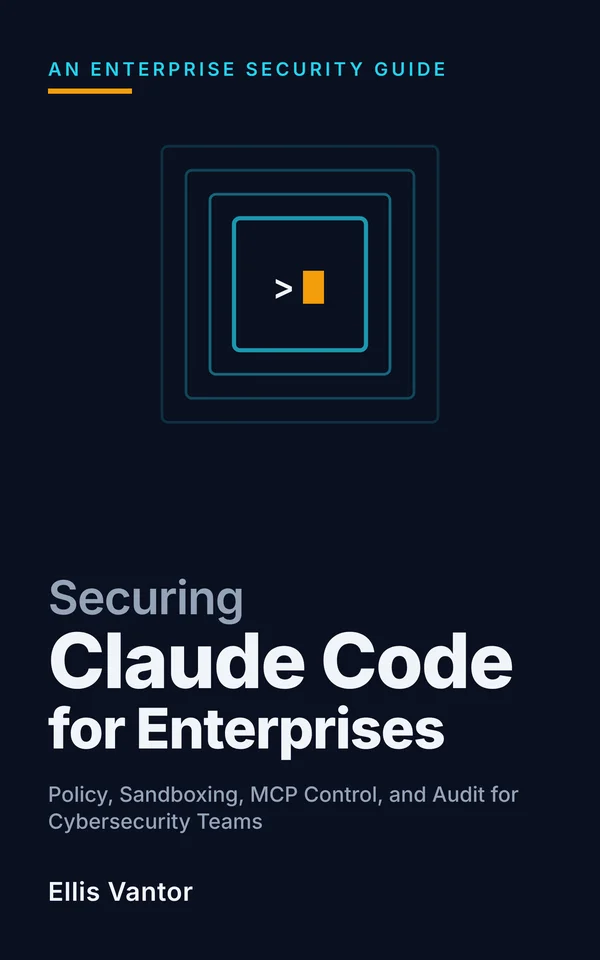
Securing Claude Code for Enterprises — by Ellis Vantor
Kindle $12.99 Paperback $29.99
256 pages · Kindle and paperback